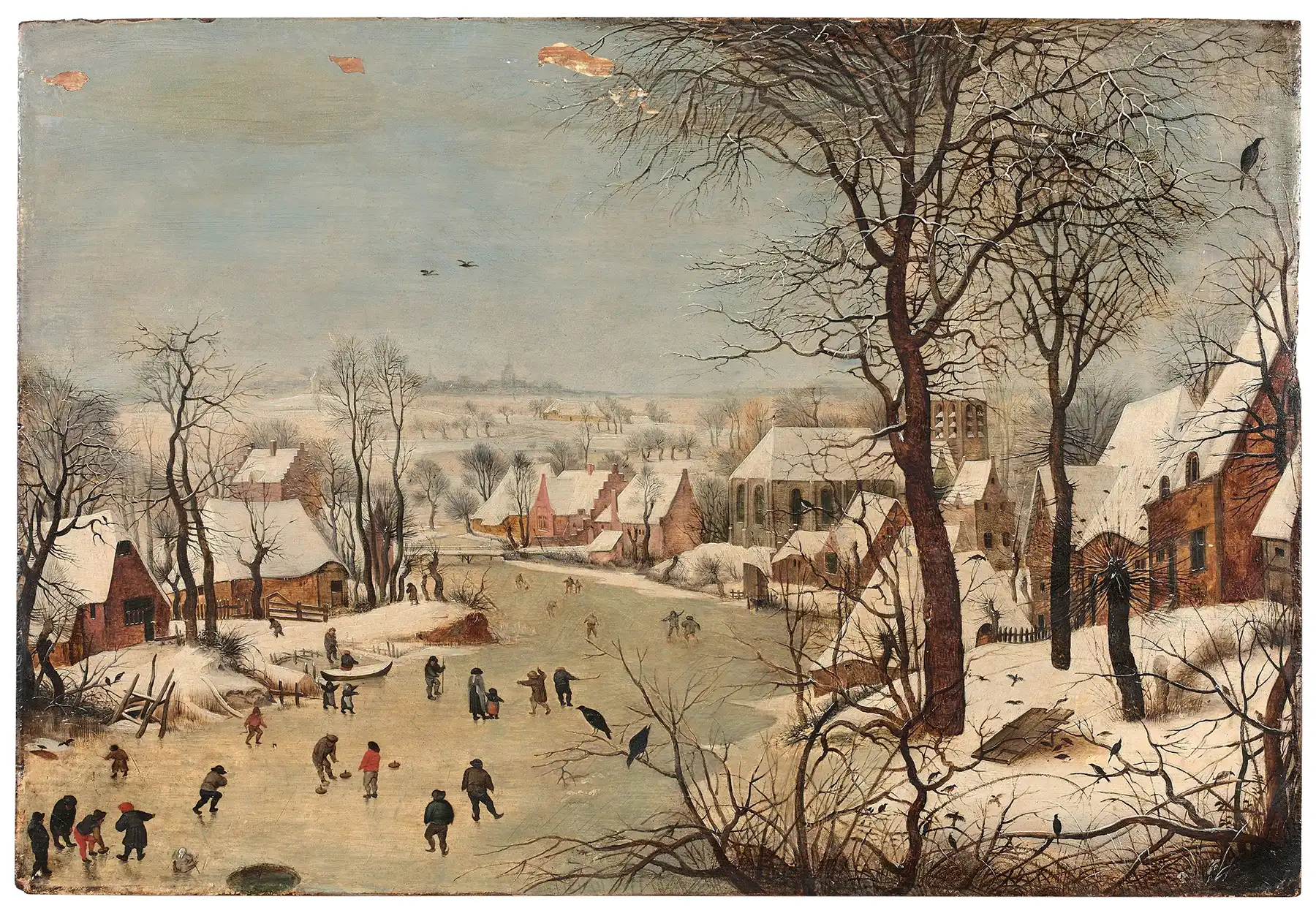
Auction on May 15, 2022: Bourgeoise Auction “Pieter Brueghel the Younger (1564/1565–1636). The Bird Trap. Parquet-style oak panel. Frame: damage to the frame. Height: 38 cm. Width: 55 cm. Missing sections and previous restorations. Expert: Stéphane Pinta - TURQUIN Gallery. The “Winter Landscape with a Bird Trap” is undoubtedly one of the most popular compositions of the Brueghel dynasty. The panel held at the Royal Museums of Fine Arts in Brussels (38 x 56 cm) is widely regarded as the prototype by Pieter Brueghel the Elder. It is dated 1565. The painting combines a moral message of vanity regarding the transience of life with an atmospheric quality, capturing the exceptional cold of winter. It was widely disseminated by his eldest son, Pieter Brueghel the Younger. Today, there are approximately 140 known versions by this artist, to which this new, previously unpublished version is added. Generally dated between 1601 and 1626—with demand being as high then as it is today—they exhibit slight variations from one another in terms of color palette or the appearance of the branches, for example. From an elevated vantage point, the viewer looks directly down upon a frozen river winding through a snow-covered village. Both banks are lined with houses, in front of which a few tall, leafless trees rise. Skaters glide across the ice, their red outfits adding a splash of color. Others are playing a game similar to modern hockey, throwing pucks and wielding sticks. The clarity of the sky, with its variations in shades of blue, creates a vivid impression of freshness. On the right, on a slope, a bird trap is ready for use. It consists of a trebuchet—made from an old door with rusted ironwork mounted on a stake—to which a rope is attached, leading to the doorway of one of the houses. Already, birds are drawn to the seeds beneath the board, where they will be trapped when the rope is pulled. The work is enlivened by numerous other birds perched on branches or flying through the sky. There has been debate as to whether this depicts an idealized valley or a specific location—perhaps the village of Sint-Anna Pade in Brabant (according to George Marlier). Others see Antwerp Cathedral rising above the city in the distance. For some scholars, beyond the description of a simple landscape, the painting’s meaning can be interpreted as symbolic of the precariousness of life: like the birds unaware of the danger, the skaters are oblivious to the daily dangers surrounding them, particularly the hole in the ice in the foreground, into which they could fall. Given the composition’s success, some have analyzed the image itself as an allegory of the occupation and the constant threat posed by Spanish rule, with the small birds symbolizing the Flemish people—once free during the glorious days of the independent free cities of the Middle Ages, and now “trapped” under Habsburg rule. A certificate from Dr. Klaus Ertz dated March 28, 2022, will be provided to the purchaser.”